Sunday, November 1, 2009

The secrets to my high releif project...


This semester I have been working on a series of high relief figurative wall tiles. These are more or less life size (big and heavy) and meant to play with an illusion of space. Figure sculpture is something relatively new to me and so my working process involves a lot of figuring it out along the way with editing and redesigning as I go along. I started out a with a firm concept and vision in mind but then went on to work somewhat intuitively. This takes awhile and what I create remains just as much a mystery to me as everyone else. To me this process is like riding a bicycle up a steep hill. Its hard work and you just keep your head down and peddle hard and its not too enjoyable, but then you reach the top and look down and think wow how the hell did I get way up here. How strange to create such personalities out of a lump of clay! Click here to see my slide show of the wet work phases of this project.

Friday, October 30, 2009

High Relief Wall Piece

My high relief tiles are three separate tiles that act as one large wall installation. These pieces are meant to emphasize the importance of the role of the predator, and its relationship to the rest of nature. The crests that surround them reference hunting, royalty, power, and legacy. The tiles that fit in between these pieces are images of the prey hunted by predators. Click here to see some images of this piece through the wetwork process and onto the final glazed form.


body casts


One of my current projects uses body castings. I started out by casting members of my family with plaster gauze, this produced the plaster negative of each chosen body section. after soaping the plaster gauze castings, I poured plaster into it to get the plaster positive of each part. Once I had the plaster positive I could proceed to make molds for slip. All in all, I have six molds: a shoulder/neck section, upper back, two knees- one including larger sections of the legs, mid-section, and an arm. This is my visual progress so far in a slideshow format.

Thursday, October 29, 2009

Craft in America, LA


Saturday night was the opening of the Craft in America KCAI ceramics exhibition in Los Angeles, CA. I was fortunate enough to be able to attend with KCAI alum Calder Kamin and Chair of the Ceramics Department Cary Esser representing the school.
The Craft in America Gallery space was opened just a few years ago by Carol Sauvion as an addition to her retail gallery "Free Hand" that she opened in 1980 in West Hollywood. The intimate space was perfect for the KCAI show and all the work looked amazing. There were many in attendance as Cary gave her lecture about the school and many questions afterward of people interested in the school's program.

Monday, October 5, 2009

Sundays at the Art Museum

Back when I was about five my Dad started taking me and my brother to the Art museum every Sunday. The reason for this is we both refused to go to Sunday school at church, and the only other person who didn't go to church was my Dad meaning that we got dragged to the museum. At such a young age we had no interest in art so we just fooled around the whole time Dad looked at paintings. As I got older I started to take an interest in certain works of art, but never enough to tolerate a whole day of this. Soon me and my brother were old enough to look after ourselves and the visits for us came to a halt. Much later when I took my first art history class in community college did I realize that I really enjoyed looking at art, and now I had learned how to decipher a meaning from the work. My Dad at this point had still been visiting the museum every week, and so I decided to give it another shot. This time going to the St. Louis Art Museum was very different I now had a critical eye and my dad now would take me through every detail of a painting down to the last brush stroke. I never was very good at two dimensional art, but now I understand it much better due to my dad's knowledge of painting. I don't know if these experiences directly effect the kind of work I do, but has had an effect on the way I feel about art and partly why I decided to pursue a career in art.

show and tell-imagined

This past week all my plans were abruptly changed drastically and I found myself five hundred miles from where I thought I would be, at my grandmother's funeral.

If this had not been the case, if I was in Kansas City on Wednesday, September the 30th, I would have attended the Show and Tell performance at the Fishtank performance studio.

This is how I imagine the night would have gone:

A few people who get up and show off new belongings: phones, children, etc.
A few people who share their past experience, a specific memory, or a place traveled.
A few people telling why they cherish a certain heirloom or a piece of trash they found in their neighbor's rubbish can.

I would leave the theatre feeling saturated with nostalgia.

What is so intriguing about these little stories, primarily unrelated to the grand scheme of life?
What if it was because they were the foundation to our lives. The small moments of joy, extreme sadness, or the broken toy you found on the ground right after you met someone who reshaped your life as you knew it.

These stories we tell and listen to let us know that we are real, we are not alone.


Maybe

I did attend a show and tell, just not the one on 1715 Wyandotte.
Many stories were told of when someone met my grandmother, of a utensil that she gave them and that they always think of her when they use it, the philosophies she instilled in her children, my mom, roadtrips they took with her, what her greatest fears were and how she overcame them, but most of all the love for her family.

My artistic experience

well... i was gonna write about hungary, but someone beat me to it. Honestly, i dont know what art is, let alone an "artistic experience", and yet, i am training to be an artist! o man, this person doesn't know what he's doing!


There is a difference between art and craft?!

Artists make art, and what is an artist? KCAI community had taught me so much about being an artist, and this is what i learned: act weird, and not care about hygiene, because thats what artists do. Artists don't do crafts, if you make functional ware, you are a craftsman. Craftsman don't belong here because it is an Art school. Making beautiful work does not make you an artist; artists shoves meaning into their work, the more philosophical the better. Spending lots of time on one piece make it a good piece of art. Artists has to be different than everyone else; having similarity with someone else's work is a big no no, especially someone 10 generations ahead of you. If you do, people will say its "Boring", or "we've seen it before", you dont want that. Male artists can't have muscles, they will be considered as a jock if they do. If you follow everything above, you are an artist, and anything you make will be considered as art.


Is that really what artist is about?

Folk Pottery in Romania

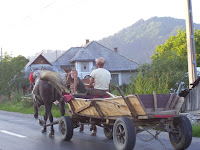
Last summer I had the pleasure of exploring Romania and a few of its famous folk pottery villages. How did I end up there? Well I had just finished my time at the International Ceramics Studio in Hungary as part of the Kansas City Art Institute summer study abroad program and couldn't bear to be so close to Romania without taking a peek. Based off the sound advice of Steve Mattison of the ICS I decided to head out into the "old world" to see how pottery has been done all along. Steve suggested the villages of Sacel and Marginea and told me that it was relatively safe and cheap to travel around Romania. So armed with a rucksack, map and lonely planet guide I headed out on my own and decided to hitchhike (at times literally on horse drawn carts) to these pottery villages. As I wound my way through many of Romania's beautiful sights I was overwhelmed by the generosity and kindness of the Romanian villagers who were all eager and proud to show off their rich heritage of folk crafts still in existence to this day.
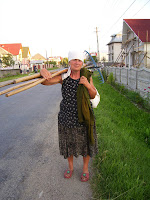
When I arrived in Sacel I asked an old woman where to find the ceramics and she led me through the narrow streets towards a workshop.
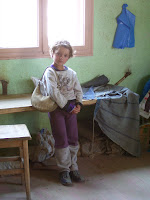
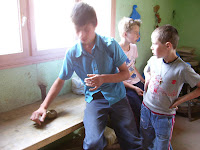
A pack of young children ran along with us and led me with excitement to the door. Steve had told me that the workshop was led by a very old man but the door was opened by a young boy who appeared to be in charge. He managed to explain that he had taken over for his passed on grandfather and was now the 17th generation to be making the same traditional pots in this space.
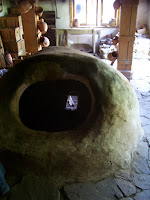
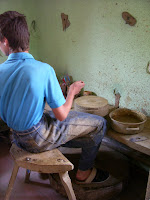
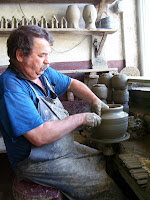
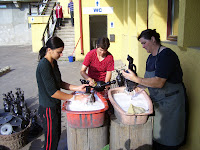
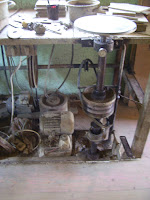
Sacel is known for its red clay pots that are decorated very minimally. When I explained to the boy that I also worked with clay he showed me around his work shop and had me try to throw a pot on his wheel. The wheel was a push wheel but rigged up to a motor that only went one fast speed. I managed to throw a nice pot (in a way that horrified the boy) but then lost it at the end because I couldn't slow the wheel down. A bit embarrassed, I was a source of much amusement to my audience of the old woman and pack of small children. In return I was quickly shown up by the boy who threw his bowl very rapidly with the precise hand gestures he had been taught by his grandfather so as to be able to replicate the same forms his family had been making for centuries. Humbled, I was allowed to check out the kiln and was then taken home by the old woman who served me lunch while she tried to convince me to move to the village and marry into the famous Sacel pottery family.


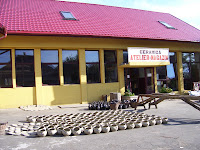
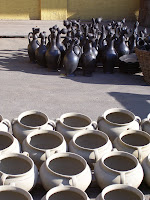
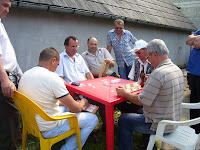
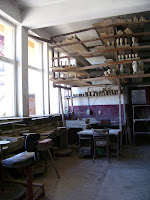
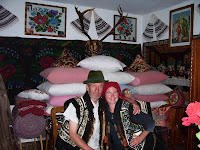
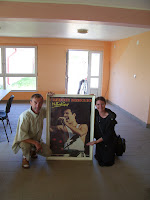
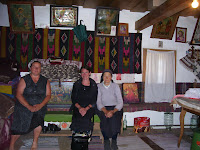
Next I headed back to the road and hitched north through the mountains to the town of Marginea which is famous for it's special black pottery. This village was a bit more developed than Sacel and the ceramic workshop was a much bigger operation, right on the road and appeared to be collectivised rather than run by one family. I arrived on a Sunday and found the workshop empty and most of the employees out in the parking lot playing some sort of gambling game. I was about to head on but took a rest on a bench out front of a house that happened to belong to the head of the workshop. "Ion" asked me where I was from and why I was on his bench and when I told him I was a Ceramic artist from America he got very excited and brought me back an old newspaper clipping. It was from years back when he and a group of Romanian potters were flown to America to be guest demonstrators at some ceramic universities. Due to the good time he had had as a visitor to America he took it upon himself to make me his guest of honor and show me a grand time in Marginea. This included an extensive tour of the pottery workshop as well as meeting his mother (who ran an old textile museum), touring his neighbors and friends' traditional homes (who insisted on dressing me up) and drinking lots and lots of vodka with his best friend (who turned out to be a goat) while dancing away to traditional music and Queen hits at the local bar.
So all and all good times were had by all in this cross cultural artists exchange. This trip taught me the importance of connecting to the roots of the craft that you pursue and also how the shared love of a craft can connect us across language and cultural divides. Pottery villages such as the ones I discovered in Sacel and Marginea have endured for centuries but are rapidly dieing out. It's important for the excellence and dedication of these pottery workshops to be documented and rightfully admired. It was life changing for me to be able to visit these places and I hope in the future there will be more programs that create the opportunity for students like me to connect to the strong folk craft roots of other cultures.


Sunday, October 4, 2009


It was weird but, never in a million years would I have ever thought I would be where I am today. I feel like when I came to the Kansas City Art Institute I was on this single track to becoming an illustrator. I would find out soon after starting freshman year that this would not be the case. If there is not an illustration department anymore what should I do? I looked and found exactly what I was looking for. It was at the end of semester ceramics show and on that night I guess I just made my mind...

Honestly I had felt like I made a mistake. I had been in this department for a year and I still felt like I had no idea what I wanted to be making. I mean everything sophomore year had been assignment based. When I looked back on my work from that year everything just looked like a bunch of experiments. Some things looked good but, not what in my mind I would consider a finished piece or anything I would be proud to say was my work. Needless to say at the end of the spring semester last year I was unhappy with my choice of direction. And I was even more worried because I was heading to Hungary and I had zero ideas of what I wanted to make or do while I was there.

So, I left, was on a plain for twenty-two hours and landed right in Budapest. Jet lag recovery for several days and I was at the international ceramics studio. Still no ideas and now I'm pretty worried. But, then it just came out of the blue. It happened while I was learning to work on the plaster wheel. It just felt like I knew what I was doing. And for my first time on the wheel I felt like I had made a successful form and a wonderful mold. After that it was like a weight of my chest I stated sketching again and I knew what I wanted to do.

I like making molds and I like working with plaster. I guess that is what I liked from the start. Here is a link to my blog where I included some pictures of my plaster wheel experience.

New Work from Poland

So Marek just sent me a link to his new exhibit called "Natura" in Poland. I was helping him with a few of the products and saw most of them from start to finish although there are some new ones.
ps. i made the molds for "Rock and Salt"

Copy/Paste this link in a new tab.

http://docs.google.com/gview?a=v&pid=gmail&attid=0.1&thid=124178514031707c&mt=application%2Fpdf&url=http%3A%2F%2Fmail.google.com%2Fmail%2F%3Fui%3D2%26ik%3Df05efce958%26view%3Datt%26th%3D124178514031707c%26attid%3D0.1%26disp%3Dattd%26zw&sig=AHBy-hZjW3QKJ8t3E-LdvQg0qr-IWzjzGQ&pli=1

Herend in Hungary


The experience I had at the Herend Porcelain Factory in Hungary was nothing short of inspiring. The tour of the factory and explanation of the processes used were a great aid to the work that I made at the International Ceramics Studio, during the Hungary 2009 study abroad trip with KCAI.
This particular image was taken inside the very large showroom at the factory. This large piece was made from about 40 different molds to make up the whole sculpture. This piece was one of my favorites because of its size, and the detail obtained from the molds. I was told it was most popular in eastern Europe and Russia because of the hunting theme.
It was the idea of making one sculpture with a complicated form, using many different molds that interested me most.
The process involved in all the pieces at Herend first began with the head designer, who makes the original pieces that are then cast. In an animal form for instance, each leg is cast seperately as well as the body and head, and any other parts. All the parts are cast at the same time, and attached at just the right dryness as they come out of the molds. I found this to be an ingenious way to cast and make multiples of complicated sculptural forms.
To be able to see such amazing sculptural works in porcelain come from molds, and see the techniques used in the factory helped me to create my own work. It is great to know that so many porcelain factories still create these masterpieces in clay for all to see.

Monday, September 21, 2009

The Meaning of Making Pots

I noticed a strange similarity the other night when browsing youtube videos...


and then i saw this...


It is funny but, as we get older we tend to forget how fun it was to be younger. It seems that in your youth it is totally cool if you are obsessed with mega-man. And its fine if you spent ungodly amounts of time working on 1:34 scale master grade models of Gundum Wing characters what else do you have to do? Third graders don't get homework.

But at some point we grow up and in this grown up state we look back on those days. We see the hour upon hours we used to spend on these things. What did that time teach us. I certainty was not ever the best at doing homework. I look back and think how I really used to just enjoy those things for the pure enjoyment of putting them together.

I started my long time love with models in small lead civil war figurines. My grandfather, who is a huge civil war buff (who's doesn't have a family member like this). Would take me to a small collectibles store near my house where we would purchase small lead soldier figurines. You would buy the figures unpainted and in a assortment of poses. We would take them home and paint them to look as close to the real soldiers in my grandfathers books as possible. We had cavalry and cannon units. Soon we were staging skirmishes and reenacting small battles.

I had gotten excited because we had accumulated about 75 different figurines and I just bought an Abraham Lincoln figure in hopes of reenacting Gettysburg.

This is when a harsh realization happened in my life. My Grandfather explained to me that our almost 75 man collection was not even close to the amount of men involved in Gettysburg. He explained that close to 93,000 men we involved in that battle. He also explained that close to 52,000 men had died in that 3 day battle. Even if it was a great turning point in the war it was a massacre for both sides.

I started to look at my figures in a different light. Each one represented a man and in the real world my 75 men would have had stories. At age 7 I started to really wonder about the world. I still have that Abraham Lincoln figurine, he reminds me of what has happened before me. I look at him some times and have a new respect for life and the future.

It is just another creature that walks the earth. With its shy nature and patches of black fur, it creeps in shadows and stands in solitude. It is nothing more than a vessel. The void with in is where I live, the emptiness inside is what makes me useful. The function is determined by the space with in, the space with in is how I shape who I am. This vessel responds to many names, but my real name is revealed only to a handful few. Persistence is how one discovers what I am. What this vessel has still remains a mystery, its attributes are what I have but does not make me what I am. My unison with my vessel makes me who I am, but tragedy and old age will take away such identity. The day will come when this vessel fulfills its purpose, and it will be the day I stop hiding.

Sunday, September 20, 2009

Clowny


Mom said no to another 'stuffed animal'. That I had enough. But I was the one in the back of our hot cream-colored van, along for the ride to every garage sale in town.

Clowny wasn't my first stuffed toy, or even my last. But she is the most memorable.

Mom picked a 'boring house'. Gaudy old jewels and lace table clothes. Where were the bright plastic toys? The Barbies and board games? I followed my mom around while she oohed and aahed at this woman's 50 year old costume jewelry and Christmas ornaments. And then I found them. The only two items a child would be interested in at this sale. Two stuffed clown dolls. There was a Raggedy Ann doll and an old blue acquaintance. I can't even remember the price, but mom said no. She wasn't being mean, she just knew I had a room full of them at home. The old woman behind the folded card table must have seen my disappointment as I walked down her drive-way, back to the family van.
Then, the lady turned me around and handed me the soft clown doll. She told me she wanted me to have it. I was speechless and so happy.

I've kept this clown doll, since named Clowny (because I felt 'Clowny' is not a boy or a girl), for over 15 years.

How did Clowny become the last toy of my childhood? Why am I still holding on?

The sentimental attachment to certain objects can be almost impossible to separate. Items are constantly moving in and out of our lives, gaining importance, losing interest. In art, we learn detachment. It's a lesson one must learn fast. Things are bound to break, crack, explode, or just disappear.

What happens as we get older, that changes our levels of emotional priority? Look around you. What is the most important object in your life right now? Why?

Where did Clowny come from? Was this the last of this woman's childhood as well? Was she detaching her emotions of one object, to give away?
If I wasn't 7 at the time, I would have thought to ask.